



Should You Choose The Elantra N Line?
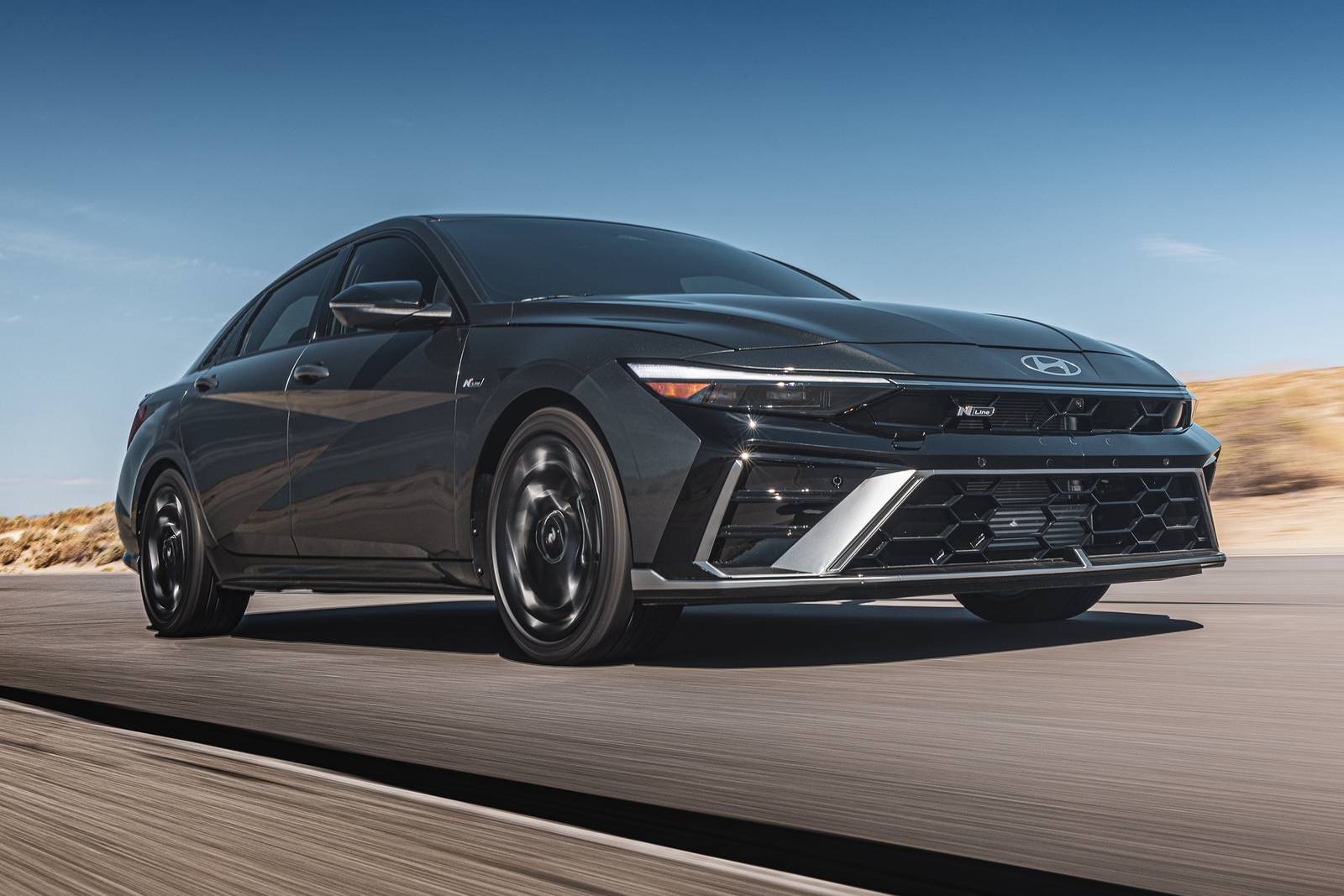
Photo Source/Copyright: Edmunds
N Line or N? One letter, two very different cars, and the showroom floor doesn’t always make that distinction obvious. The Hyundai Elantra N Line is the sport trim of the standard compact sedan, tuned and equipped for drivers who want responsive handling on their daily commute. The N is a standalone performance model featuring a larger engine and track credentials.
The Engine Under That Hood
Under the hood sits a 1.6-liter turbocharged four-cylinder engine producing 201 horsepower at 6,000 revolutions per minute (RPM). More importantly, it yields 195 pound-feet of torque starting at 1,500 RPM and holding through 4,500 RPM. That 3,000-RPM torque plateau means the car pulls immediately at 30 miles per hour (MPH) in city traffic without needing high revs.
A quick-shifting seven-speed dual-clutch automatic (DCT) with steering-wheel paddle shifters manages gear changes. Compared to the 147-horsepower 2.0-liter engine in the SE through Limited trims, the N Line adds 54 horsepower and 63 pound-feet of torque.
The Parts You Don’t See
Badges are easy, but hardware isn’t. Most of what sets this trim apart is built underneath where you can’t see it with the hood shut. A sport trim that only looks fast gets found out in the first corner. Here’s what changes underneath:
- Rear Suspension: Multi-link independent suspension: a setup exclusive to this trim among gas-powered configurations.
- Brake Hardware: Upgraded 12-inch front brake rotors.
- Wheels and Tires: 18-inch alloy wheels wrapped in 235/40 R18 performance all-season tires.
- Drivetrain: A 7-speed dual-clutch transmission replacing the Continuously Variable Transmission (CVT) found across the rest of the standard lineup.
- Drive Mode Select: Driver-selectable Normal, Sport, and Smart modes.
Interior Comfort and Technology
The cabin is equally focused. Standard features include N Line sport seats in a leather and cloth combination, an eight-way power driver’s seat with power lumbar support, heated front seats, alloy pedals, a leather-wrapped steering wheel and shift knob, a black headliner, and a power sunroof.
Dual 10.25-inch displays face the driver: one touchscreen for navigation and one digital gauge cluster. Bose handles audio through an eight-speaker setup with a center channel and subwoofer. Wireless device charging, Bluelink+, Hyundai Pay, and a hands-free smart trunk round out the package. Passenger room measures 99.4 cubic feet, while the 14.2-cubic-foot trunk easily swallows weekend luggage.
Where This One Stops and the N Begins
Stepping up to the full N model changes the recipe entirely. A 2.0-liter turbo engine generates 276 horsepower and 289 pound-feet of torque, mated to either a standard six-speed manual or an optional eight-speed wet dual-clutch.
Pushing the N Grin Shift button on DCT models overboosts output to 286 horsepower for up to 20 seconds. It also adds an electronic limited-slip differential, 14.2-inch front rotors, Launch Control, and requires premium fuel.
| Feature | N Line | N |
|---|---|---|
| Engine | 1.6L Turbo GDI I-4 | 2.0L Turbo I-4 |
| Horsepower | 201 | 276 (286 with NGS) |
| Torque | 195 lb-ft | 289 lb-ft |
| Transmission | 7-speed DCT | 6-speed manual or 8-speed wet DCT |
Pricing, Efficiency, and Practical Trade-Offs
Starting MSRP is $29,600 (excluding destination fee). EPA estimates are 28 miles per gallon (MPG) city, 35 MPG highway, and 31 MPG combined.
Compared to the 30/40/34 MPG returned by SEL trims, you trade roughly four combined MPG for 54 extra horsepower, multi-link rear suspension, and upgraded brakes. By comparison, the N model posts 20/27/23 MPG, which is where the true efficiency penalty sits.
Some trade-offs exist: Smart Cruise Control with Stop & Go and Highway Driving Assist are reserved for SEL Sport Premium and Limited trims to prioritize chassis development. Smartphone mirroring is wired rather than wireless to accommodate the larger screen and Bose audio system, and suspension tuning is firm.
However, standard safety gear remains complete:
- Forward Collision-Avoidance Assist with Pedestrian Detection
- Blind-Spot Collision Warning and Rear Cross-Traffic Collision-Avoidance Assist
- Lane Keeping Assist, Lane Following Assist, and Driver Attention Warning
- Safe Exit Warning and High Beam Assist
Schedule a Test Drive
On-paper specifications only convey part of the experience. Visit our showroom to test drive our in-stock N Line inventory and evaluate the differences firsthand. Schedule your test drive today.
More From Southern Hyundai Newport News
Secrets Behind Hyundai Kona Gas Mileage Revealed
Photo Source/Copyright: Hyundai USA If you’re shopping for a subcompact crossover, odds are high that fuel economy sits right at the top of your checklist. The Hyundai Kona addresses this need directly with a headline figure of 31 miles per gallon (MPG) combined (and up to 35 MPG on the highway) in its…
Hyundai Santa Fe Interior Size: Full Guide
Photo Source/Copyright: Hyundai USA Three rows in a midsize SUV usually means somebody’s knees pay for it. Hyundai took a distinct route with the Santa Fe: a squared-off roofline, upright rear glass, and a tailgate opening wide enough to swallow a flat-pack bookshelf without any wrestling. Shoppers researching Hyundai Santa Fe interior size…
Is the Hyundai Elantra Compact Sedan Worth It?
Photo Source/Copyright: Hyundai USA The Elantra, a compact sedan, is available with a 2.0-liter four-cylinder engine, a turbocharged 1.6-liter engine, or a hybrid option, and the EPA combined fuel economy ranges from 31 miles per gallon (MPG) to 54 MPG. That’s an unusually large difference within one model lineup. There’s a difference of…